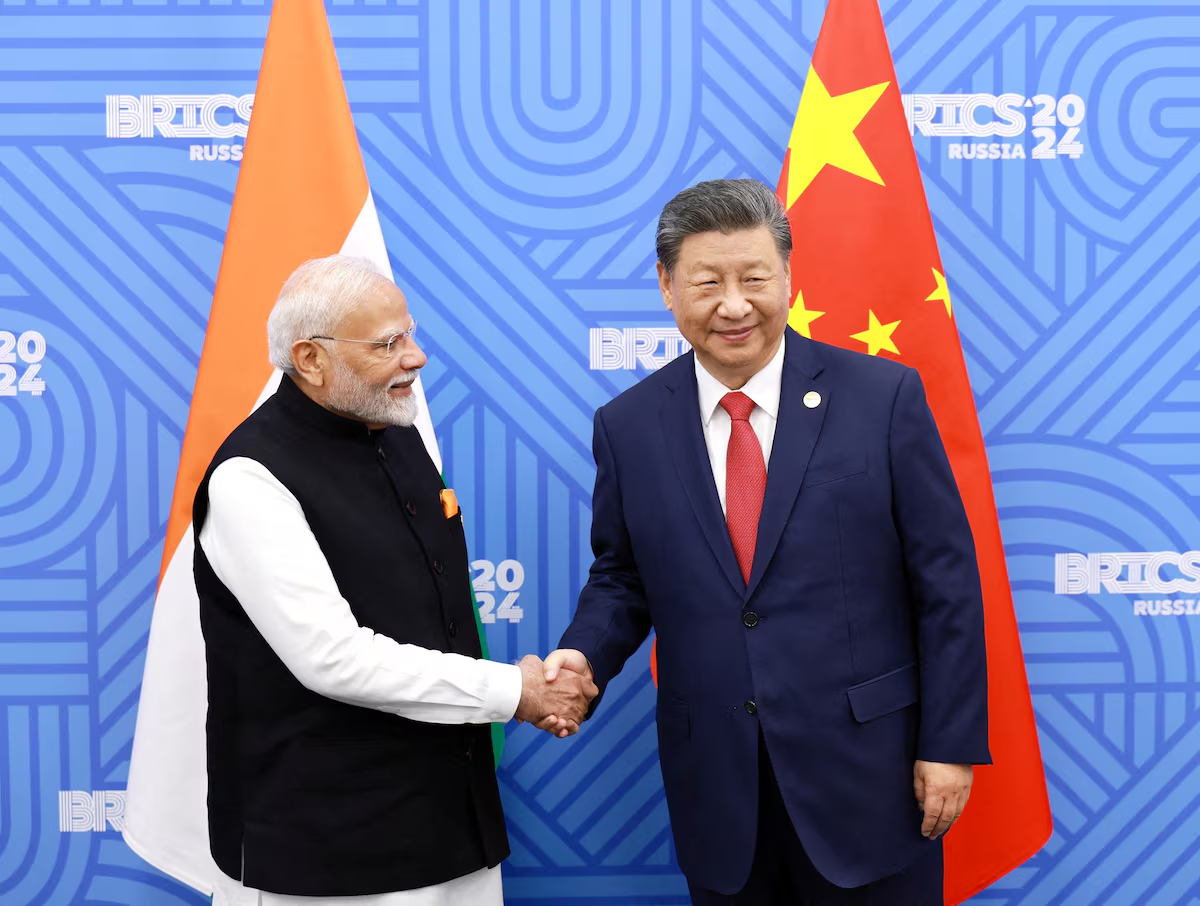
The troubled India-China bilateral relationship is moving towards a tentative and hesitant rapprochement in 2026. If this improvement in relations is realized in its totality and sustained for the long term, such a harmonious geo-political orientation has the potential to shape the Asian and global strategic framework in a significant manner. The once touted ‘Asian century’ could become a reality in the latter half of this century – but this is aspirational.
Both Asian giants, with a combined population closer to three billion are complex nations, with an ancient civilizational pedigree but a more recent and checkered history as modern entities. Subjected to the vicissitudes of western imperialism, India became independent in 1947 and communist China in 1949 – and the early years were heady. Having cast aside the colonial yoke, Asian solidarity was the flavor of the 1950’s and ‘Hindi-Chini bhai-bhai’ (Indians and Chinese are brothers) was a popular slogan in India.
However territoriality became a prickly issue, given that they were both inheritors of ‘empire’ where frontiers (identified in a broad-brush manner) were kinetic and often moved with a military major defeat or conquest. Thus when India and China became independent in the late 1940’s – there was no consensually accepted border across the 4,000 kilometer divide that separated the two giants.
The yet to be determined border runs through the high Himalayas that once served as a barrier for millennia and extends from west to east – culminating in the jungles of eastern India abutting South East Asia.
In October 1962, China attacked India for what Beijing considered to be incursions across this notional border as part of then PM Nehru’s ‘forward policy’. The PLA forced the Indian army to pull back in disarray. This military act surprised and stunned Delhi, which had not expected such an act of escalation and aggression. This attack has remained a scar on the Indian collective consciousness.
Sino-Indian relations went into a deep freeze and occasional skirmishes took place with both armies on alert. A major clash occurred in 1975 with fatalities but this was played down. The bilateral relationship remained brittle. It took 26 years after the 1962 border war for the beginning of a thaw. Then PM Rajiv Gandhi made a visit to China in December 1988 and his meeting with Deng Xiaoping marked the end of hostilities and estrangement.
The period 1988 to 2020 was one of steady improvement in the India-China bilateral and various major agreements were concluded, including those related to the maintenance of peace and tranquility on the LAC – the Line of Actual Control. This nomenclature was introduced in the absence of an agreed border and the complex and tangled territorial dispute was kept on the back-burner. Occasional transgressions by border patrols from either side were dealt with in a non-provocative manner – and it appeared that the bilateral relationship was relatively stable and crisis proof.
Beginning early 2000, Delhi managed to improve its relationship with Washington and this culminated in India being accorded special status in the global nuclear domain – much to Beijing’s chagrin. China was wary of the rapid improvement in India-US ties. The traction imparted to the Quad group (USA, Japan, Australia and India) apropos the Indo-Pacific during US President Biden’s tenure added to China’s strategic anxiety.
After President Xi Jinping assumed office in November 2012 and PM Modi in May 2014 – there was expectation (misplaced clearly) that the bilateral would stabilize and the Asian giants would arrive at a modus vivendi over the festering territorial dispute. But this was not to be and India accused China of incursions beginning with Depsang and later in Chumar and Doklam along the LAC. But the 1993 Peace and Tranquility agreement remained in place – albeit uneasily – and not a shot was fired in anger by either army.
In June 2020 Chinese troops clashed violently with an Indian patrol in the Galwan valley in Ladakh in the Himalayas resulting in the death of troops on both sides. This was the first time that the two armies engaged in combat (with clubs and similar weapons but no bullets) after 1975 and the bilateral relationship went back into deep freeze.
The current thaw began when PM Modi visited China in August 2025 to attend the Shanghai Cooperation Organisation (SCO) Summit in Tianjin. This was Modi’s first visit to China since 2018 and after the Galwan clash in 2020. It is evident that his meeting with President Xi Jinping and Russian President Putin enabled this tentative rapprochement.
It merits notice that the global backdrop to this thaw was the unexpected and harsh tariff tirade unleashed by US President Trump (who assumed office for his second term in January 2025) that targeted both China and India. In summary, the most dramatic ‘higher’ tariffs on China started early 2025 (February–April), while on India they peaked in August 2025 – going up to 50%.
With trade protocols being weaponized by the world’s most prosperous and powerful nation, strategic prudence warranted that other major powers move from estrangement to cautious engagement – and this is more than evident in the case of the China-India rapprochement.
Yet another facet of southern Asian geo-political contestation is instructive. Pakistan is an abiding factor in the Indian security and strategic calculus and the growing China-Pakistan military cooperation has added to the wariness inherent in the India-China bilateral. In June 2025, India mounted Operation Sindoor against terrorist assets in Pakistan following an attack in Pahalgam in Kashmir. Both sides used air power and missiles in the short conflict.
China was perceived to have provided critical military support to Pakistan to blunt the Indian conventional military advantage. Notwithstanding this provocation, Delhi opted to engage with Beijing–an opportunity which the SCO summit provided.
Direct flights have resumed and trade restrictions are being eased and greater contact is being encouraged – both at the official level and in Track 2 engagement. Will the dragon and the elephant begin to dance? Not in a hurry – in my opinion. Challenges persist, including unresolved territorial disputes, trade imbalances and deeply embedded strategic rivalry and suspicion. India’s trade deficit with China remains significant, and Beijing’s assertiveness in the Indian Ocean raises concerns in Delhi.
The best case scenario would be a definitive strategic determination by China that Beijing would not seek to constrain India’s growth or stoke its security anxieties. This would enable a robust bilateral partnership to sustain the BRICS (Brazil, Russia, India, China, South Africa) agenda and that of the G 20.
The worst-case exigency would be a flare up of the festering territorial dispute peaking in a Galwan plus-plus mode with the two militaries exchanging ordnance. This would roil Asian geo-politics in a negative manner and add to the insecurities that already plague the world.ive manner and add to the insecurities that already plague the world.
Commodore C Uday Bhaskar (Ret.) is the Director of the Society for Policy Studies (SPS), New Delhi, India.
Leave a Reply